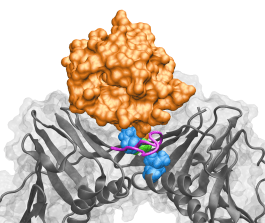
Computation and experiment reveal how protein switching provides right tool for the job
Source: Researchers Show How Proteins Help DNA Replicate Past a Damaged Site
Computation and experiment reveal how protein switching provides right tool for the job
Source: Researchers Show How Proteins Help DNA Replicate Past a Damaged Site
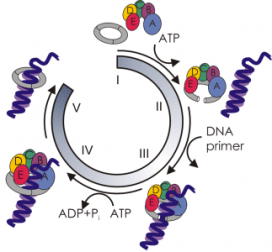
Scientists use Jaguar to model replisome components to understand their role in health and disease.
Source: Supercomputers Simulate the Molecular Machines that Replicate and Repair DNA
Ivaylo Ivanov, associate professor of chemistry at Georgia State University, has received a five-year, $1.675 million federal grant to study how problems with DNA replication and repair may lead to cancer susceptibility and inheritable genetic diseases.
Source: Georgia State scientist gets $1.675 million to study link between cancer and DNA replication, repair

“New study provides a framework for understanding how protein works and how it stimulates the DNA processing machines” Source: Oak Ridge National Laboratory

The National Institute of General Medical Sciences (NIGMS) has funded our project “Integrative Modeling of PCNA Assemblies Engaged in Genome Duplication and Repair” as a 5-year R01 grant.

The Journal of Computational and Structural Biotechnology has just published our invited review paper ‘Integrative Modeling of Macromolecular Assemblies from Low to Near-Atomic Resolution’.

Another paper, ‘Functional Dynamics in Replication Protein A DNA Binding and Protein Recruitment Domains’ has also appeared in Structure.
Our paper ‘Structurally Distinct Ubiquitin- and Sumo-Modified PCNA: Implications for Their Distinct Roles in the DNA Damage Response’ has been published by the journal Structure.

Congratulations to Shih-Wei Chuo who successfully defended his M.S. thesis and received a masters degree in May 2015! Shih-Wei will continue his studies toward a Ph.D. degree at the University of California and we wish him all the best in his future endeavors.

Our paper ‘Alkylpurine Glycosylase D Employs DNA Sculpting as a Strategy to Extrude and Excise Damaged Bases’ was published in PLOS Computational Biology. We employed chain-of-replicas path optimization strategy to determine a minimum energy path (MEP) for flipping out a 3-methyl adenine lesion by the DNA glycosylase AlkD. The path showed that AlkD acts by sculpting the global DNA conformation to achieve lesion expulsion. From the MEP we computed an effective free energy profile and delineated the energetics of base extrusion.
Congratulations to Max Xu who successfully defended his doctoral dissertation on March 26th 2014! Max is the first Ph.D. recipient from our group and we wish him all the best in his future endeavors.

Our paper ‘Diamidine Compounds for Selective Inhibition of Protein Arginine Methyltransferase 1’ has just been accepted by the Journal of Medicinal Chemistry. Misregulation of protein arginine methyltransferase enzymes (PRMTs) have been linked to many pathological conditions. In collaboration with Dr. Zheng’s group at UGA we report diamidine compounds as specific inhibitors of PRMT1, the primary type-I PRMT. Docking, molecular dynamics and MM/PBSA analysis together with biochemical assays were conducted to understand the binding modes of these inhibitors and the molecular basis of selective inhibition for PRMT1.

Our paper ‘Opening Pathways of the DNA Clamps Proliferating Cell Nuclear Antigen and Rad9-Rad1-Hus1’ has just been accepted by the journal Nucleic Acids Research. The recently solved structures of the DNA clamp protein 9-1-1 led to competing proposals regarding how 9-1-1 is loaded onto DNA. Through detailed subunit interface analysis, we identified the subunit interface which is least substantial and, therefore, serves as the opening gate for loading 9-1-1 onto chromatin. Using external forces as a surrogate of the clamp loader we also identified the dominant pathways for interface disruption in the clamp proteins PCNA and 9-1-1.

Our paper ‘Probing DNA clamps with single-molecule force spectroscopy’ has just been published in Nucleic Acids Research and sheds light on the mechanisms of DNA clamp opening under external forces by combining molecular simulation with single-molecule micromanipulation experiments.
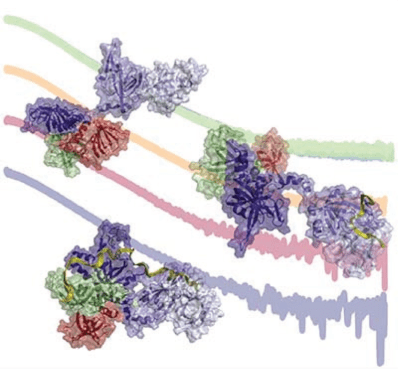
Oak Ridge National Lab highlights our recent work on Replication Protein A:‘Neutrons help shed light on critical protein activity that protects our DNA’.

Our paper ‘A new structural framework for integrating replication protein A into DNA processing machinery’, which is currently in press in Nucleic Acids Research, has been selected as a ‘featured paper’ in the top 5% of NAR submissions.
Ivaylo Ivanov receives a Dean’s Early Career Award from Georgia State University.

A News and Views article on the role of metal cofactors in CDK2 kinase is currently in press in Nature Chemistry.

Our collaborative efforts with Berkeley/LBNL have led to a combined experimental/computational publication ‘Repair complexes of FEN1, DNA and Rad9-Hus1-Rad1 are distinguished from their PCNA counterparts by functionally important stability’ currently in press in Proceedings of the National Academy of Science U.S.A.

Ivaylo Ivanov receives a five year NSF-CAREER Award from the National Science Foundation.

Our PNAS paper on PCNA ubiquitylation has been selected and evaluated by the post-publication peer review service Faculty of 1000 (F1000). According to the F1000 service this places our work in “.. the top 2% of published articles in biology and medicine”.

The Oak Ridge Leadership Computing Facility at Oak Ridge National Laboratory highlights our work on PCNA ubiquitylation and translesion synthesis.

Our proposal for computational time on the special purpose Anton machine at the National Resource for Biomedical Supercomputing (NRBSC) in Pittsburgh is approved.

Our collaborative efforts on PCNA ubiquitination with Berkeley Lab, Univ. of Iowa and Univ. of Delaware led to a combined experimental/computational publication currently in press in Proceedings of the National Academy of Science U.S.A.

Ivaylo Ivanov receives NERSC Initiative for Scientific Exploration (NISE) Award.
Our collaboration with the group of Prof. Zheng on histone acetylation has led to a combined experimental/computational paper available from the Journal of Biological Chemistry.
Ivaylo Ivanov receives a XSEDE award of computational time at the NICS to futher our research efforts on base excision repair. Our proposal entitled “Exploring the Chemical Landscape for Base Excision DNA Repair” was approved to receive 2,500,000 CPU hours under allocation CHE110042.
Ivaylo Ivanov receives a Cleon C. Arrington Research Initiation Grant, which will help with establishing our new research program on eukaryotic clamp loading.

Ivaylo Ivanov attended the Keystone Symposium on DNA Replication and Recombination and presented our new findings on the flexible association of ubiquitin and PCNA.


Two recent papers on ligand-gated ion channels (LGICs) have been published and available from the Biophysical Journal and Proteins: Structure, Function and Bioinformatics.

Our work on PCNA highlighted by the NCCS at Supercomputing 2010 Conference in New Orleans.
Chunli Yan is joining our group as a new postdoctoral scholar. She comes to us from the University of Texas, Austin. Welcome Chunli!
Carlo Guardiani who was with us for a year as a postdoctoral scholar is moving back to Italy to assume a new position at the University of Florence. We all want to thank him for his hard work and for helping set our group on the right track from the very beginning.
Max Xu has successfully completed all requirements for the Ph.D. other than the dissertation and advances to candidacy. Congratulations!
Scientists use Jaguar to model replisome components to understand their role in health and disease.
Source: Supercomputers Simulate the Molecular Machines that Replicate and Repair DNA
Our first paper from GSU is published and available from the web site of the Journal of the American Chemical Society.

Our renewal proposal through the DOE INCITE initiative was awarded 4,000,000 CPU hours at the leadership computing facility at ORNL. We are gratified that the award exceeded our original request by 400,000 units
For more details about the award refer to the new DOE Office of Science.

A renewal proposal for computational resources through the DOE INCITE initiative has been submitted (07/01/2009). In 2009 our research project entitled “Interplay of AAA+ molecular machines, DNA repair enzymes and sliding clamps at the replication fork: A multiscale approach to modeling replisome assembly and function” was competitively chosen to receive 2,600,000 CPU hours of supercomputing time on the Jaguar machine at Oak Ridge National Lab. In 2010 we expect to receive an additional 3,600,000 units.
2009 Two new members join our group. Carlo Guardiani is a postdoctoral scholar who comes to us from the University of Florence in Italy. Max Xu joins us as an incoming Ph.D student. Welcome!

