Research › Transcription
Transcription: how genes are switched on
Every gene begins with transcription initiation. RNA polymerase II cannot find or open a promoter on its own: it relies on a set of general transcription factors that assemble with it into the preinitiation complex (PIC), and on the Mediator coactivator, which relays signals from gene-specific transcription factors. Loss of this regulatory control is a hallmark of cancers and of neurological, metabolic and developmental diseases.
Working closely with cryo-EM groups, we build complete atomic models of these assemblies and simulate how they move, open DNA and pass regulatory signals from one part of the complex to another.
Questions we ask
- How is promoter DNA opened and loaded into the polymerase?
- How do the many subunits of the initiation machinery communicate?
- How do mutations in shared factors such as TFIIH produce distinct diseases?
- How does Mediator integrate signals from transcription factors into the decision to transcribe?
What we have found
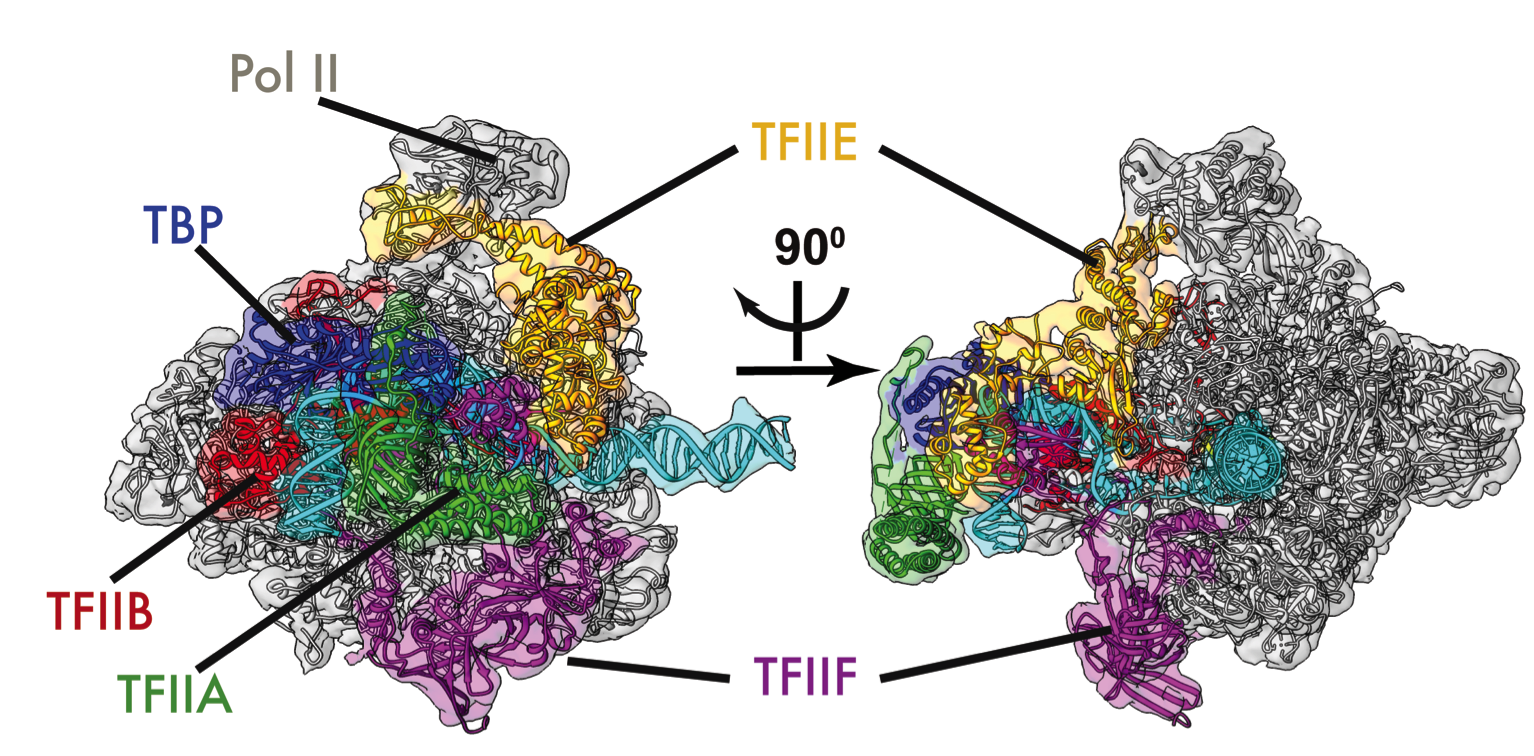
Visualizing promoter opening
Near-atomic cryo-EM structures combined with our modeling captured the human initiation machinery in the act of opening promoter DNA. Related work revealed how RNA polymerase I initiates without ATP and visualized the RNA polymerase III initiation machinery.
He et al., Nature 2016; Han et al., eLife 2017; Han et al., Cell Discovery 2018

The preinitiation complex with an atomically resolved TFIIH
We built the first near-complete model of the human Pol II preinitiation complex with an atomically resolved TFIIH, and performed the first molecular dynamics simulations of the human initiation machinery. The simulations showed how the TFIIH motor XPB drives duplex DNA toward the polymerase cleft to open the promoter.
Yan et al., Nature Structural & Molecular Biology 2019 (recommended by Faculty Opinions)
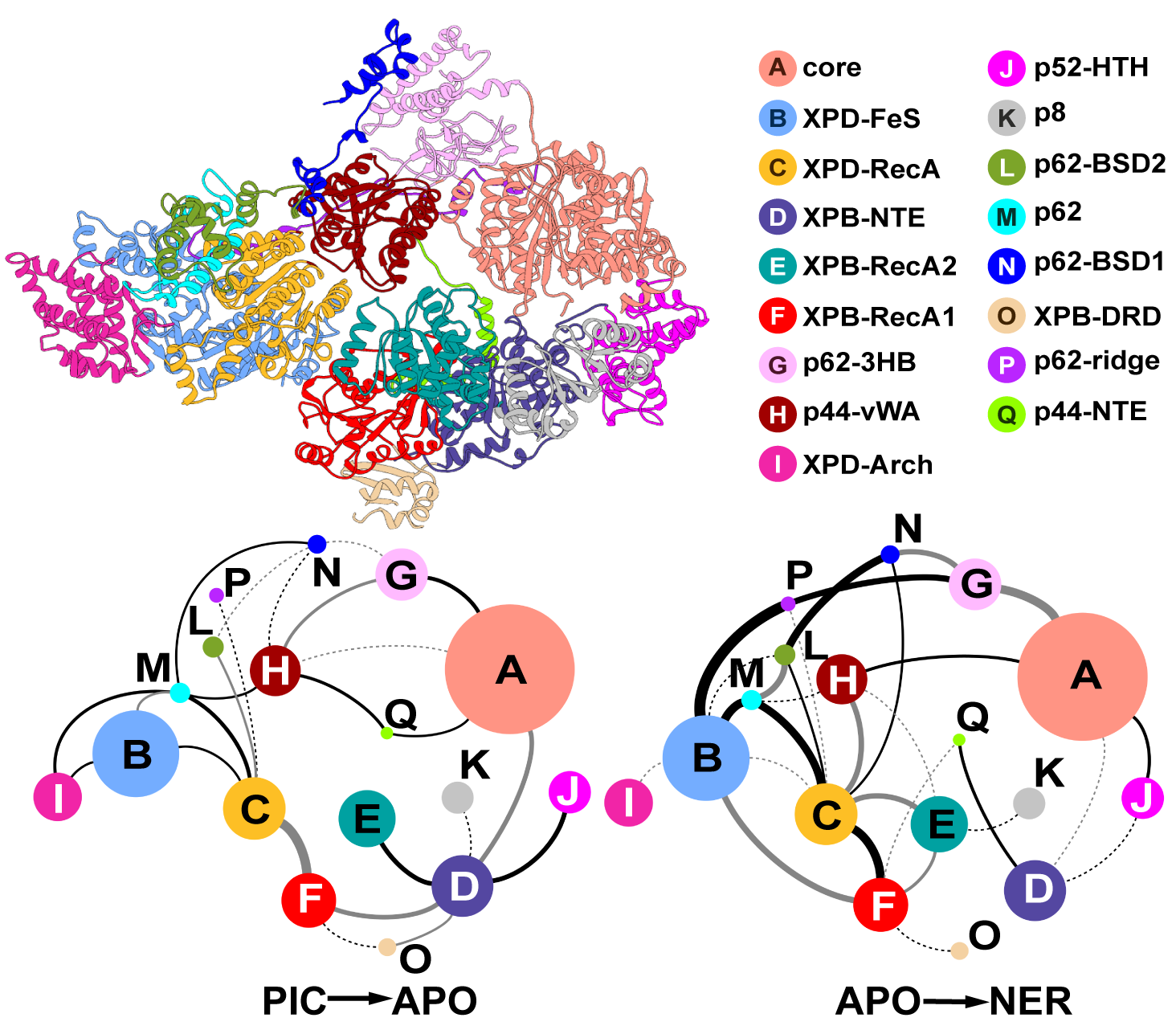
Dynamic communities and the origins of disease
The same simulations revealed that the PIC is organized into a hierarchy of coordinated dynamic communities. Patient-derived mutations concentrate at the interfaces and highly connected nodes of this network, which helps explain how lesions in one shared complex produce three different disorders. In transcription factors themselves, we have shown how distal substitutions reshape DNA specificity and how hidden allosteric networks control coregulator selection.
Yan et al., NSMB 2019; Hudson et al., PNAS 2016; Musille et al., JBC 2016
Current directions
Our current work turns to Mediator and the Mediator-bound preinitiation complex, an assembly of more than seventy protein chains. We are asking how it assembles, what its large-scale rearrangements accomplish, how it is taken apart when the polymerase escapes the promoter, and what roles Mediator’s many disordered regions play. Mapping disease mutations onto these models aims at a dynamics-aware classification of transcription-linked disease mutations.
Key papers
- Mechanism of Rad26-assisted rescue of stalled RNA polymerase II in transcription-coupled repair
Yan, Dodd, Yu, Leung, Xu, Oh, Wang & Ivanov · Nature Communications 12, 7001 - Envisioning how the prototypic molecular machine TFIIH functions in transcription initiation and DNA repair
Tsutakawa, Tsai, Yan, Bralić, Chazin, Hamdan, Schärer, Ivanov & Tainer · DNA Repair - Transcription preinitiation complex structure and dynamics provide insight into genetic diseases
Yan, Dodd, Tainer, He, Tsutakawa & Ivanov · Nature Structural & Molecular Biology 26, 397–406 - Structural visualization of RNA polymerase III transcription machineries
Han, Yan, Fishbain, Ivanov & He · Cell Discovery - Structural mechanism of ATP-independent transcription initiation by RNA polymerase I
Han, Yan, Nguyen, Jackobel, Ivanov, Knutson & He · eLife 6, e27414 - Near-atomic resolution visualization of human transcription promoter opening
He, Yan, Inouye, Fang, Tjian, Ivanov & Nogales · Nature 533, 359–365 - Distal substitutions drive divergent DNA specificity among paralogous transcription factors through a subdivision of conformational space
Hudson, Kossmann, de Vera, Chuo, … Ivanov, Kojetin & Ortlund · PNAS 113, 326–331

