Research › DNA repair
DNA repair: how cells find and remove damage
DNA is damaged thousands of times a day in every cell, by ultraviolet light, by chemical carcinogens and by many chemotherapy drugs. Nucleotide excision repair (NER) is the cell’s most versatile defense: it recognizes a remarkably broad range of bulky, helix-distorting lesions, cuts out the damaged stretch and fills the gap. Inherited defects in NER cause xeroderma pigmentosum, Cockayne syndrome and trichothiodystrophy, three disorders with strikingly different outcomes.
At the heart of NER is TFIIH, a ten-subunit complex that also opens promoter DNA during transcription. We build integrative models of the repair machinery from cryo-EM, crosslinking mass spectrometry and AI-based structure prediction, then use simulation to recover the motions that connect one step of the pathway to the next.
Questions we ask
- How does one complex, TFIIH, serve both transcription and repair without the two tasks interfering?
- How are the repair factors assembled in the right order, and how is the irreversible incision held in check until damage is verified?
- How does the XPD helicase scan DNA and recognize a lesion?
- Why do mutations in the same proteins cause three clinically distinct diseases?
What we have found
A switch that lets TFIIH do one job at a time
TFIIH works through two DNA motors, XPB and XPD. Building cryo-EM based models of TFIIH in its transcription and repair states, we uncovered an internal regulatory mechanism that makes the activities of the two motors mutually exclusive between the pathways. By sequencing the XPB and XPD unwinding steps, the switch ensures precise DNA incision in repair. Mapping disease mutations onto our network models sorted them into distinct mechanistic classes.
Yu et al., Nature Communications 2023
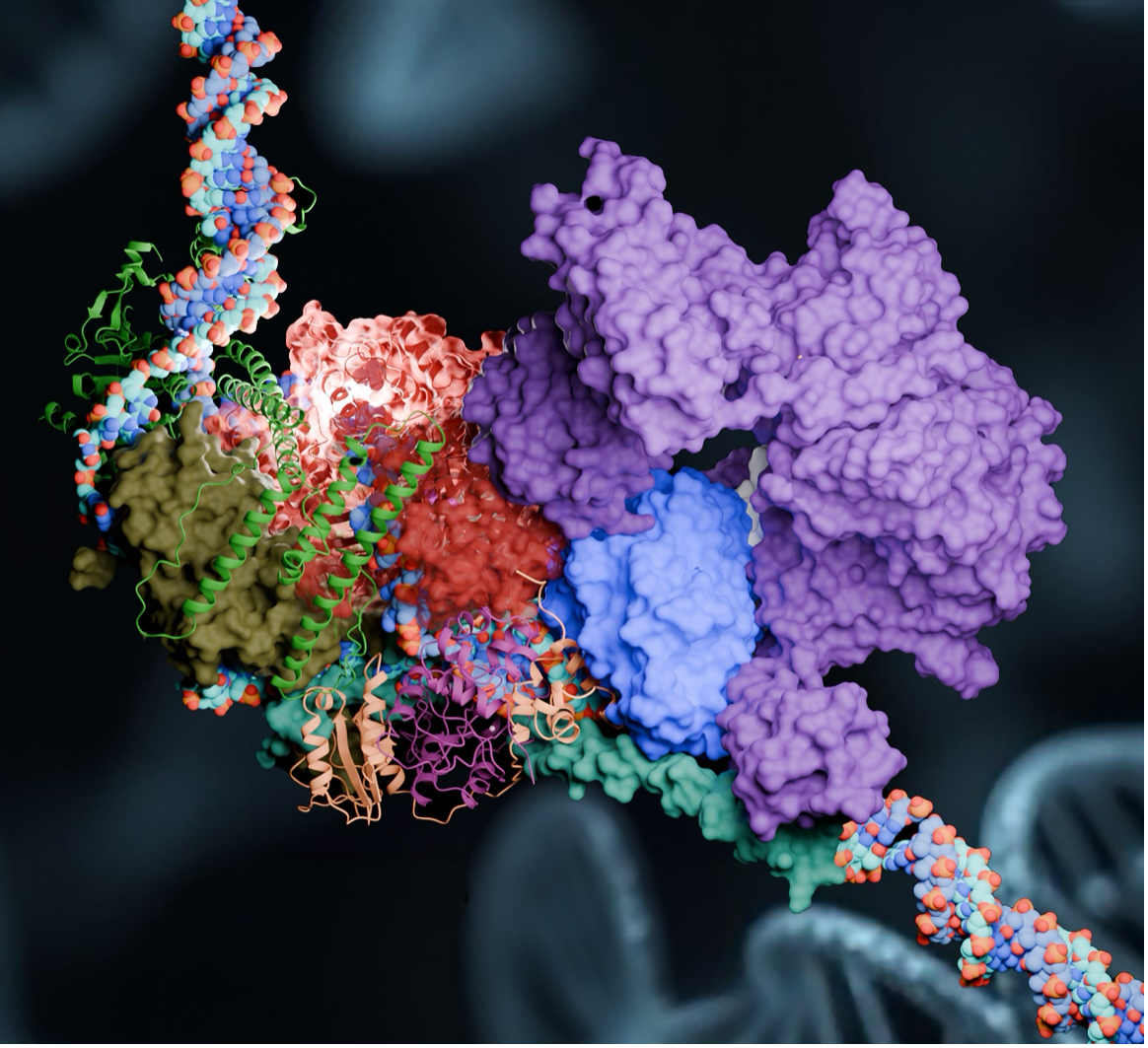
The pre-incision complex and TFIIH as a molecular ruler
Combining cryo-EM and crosslinking data with AlphaFold2 predictions, we built an integrative model of the NER pre-incision complex. TFIIH acts as a molecular ruler: it sets the size of the DNA repair bubble and positions the XPG and XPF nucleases for incision. XPG caps the DNA-binding groove of XPD and bridges both junctions of the bubble, suggesting how the two incisions are coordinated, while XPA links XPF–ERCC1 to RPA, XPD, XPB and single-stranded DNA.
Yu et al., Nature Communications 2024
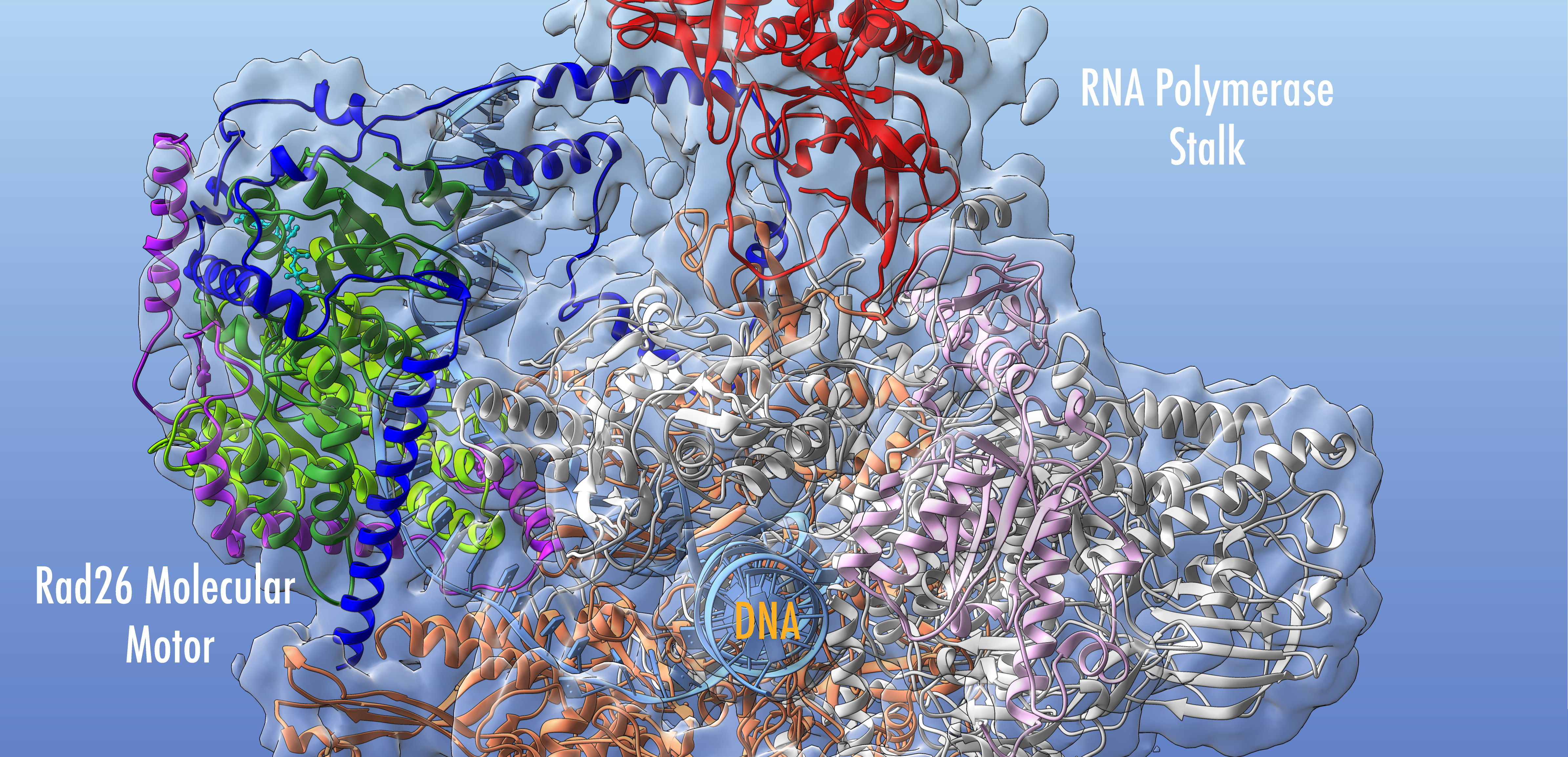
Repair coupled to transcription
When RNA polymerase II stalls at a lesion, the CSB protein (Rad26 in yeast) decides whether the polymerase is pushed past the damage or repair is triggered. Our models of Rad26 bound to Pol II revealed an allosteric pathway that couples the motor’s ATPase modules to changes in the polymerase and DNA, explaining how CSB helps Pol II past less bulky lesions and how Cockayne syndrome mutations derail it.
Yan et al., Nature Communications 2021

Recruiting TFIIH to a stalled polymerase
Combining existing structures with AlphaFold predictions, we built an integrative model of TFIIH bound to the initial transcription-coupled repair complex. TFIIH is first recruited in an open, repair-inhibited form that must close before it can process damaged DNA. STK19 acts as a linchpin of the assembly, orienting the incoming TFIIH and bridging Pol II to the core repair factors and DNA.
Paul et al., Nature Communications 2025
How XPD walks along DNA
XPD scans single-stranded DNA to verify damage. Using simulations and chain-of-replicas path optimization, we modeled the complete ATP-driven translocation cycle of XPD and its bacterial homolog DinG, identifying every metastable intermediate along the way. Alternating weak and strong grip at two constrictions of the DNA-binding groove lets the motor inch forward, and the residues that drive this motion are hotspots for disease mutations.
Paul et al., Nature Communications 2025
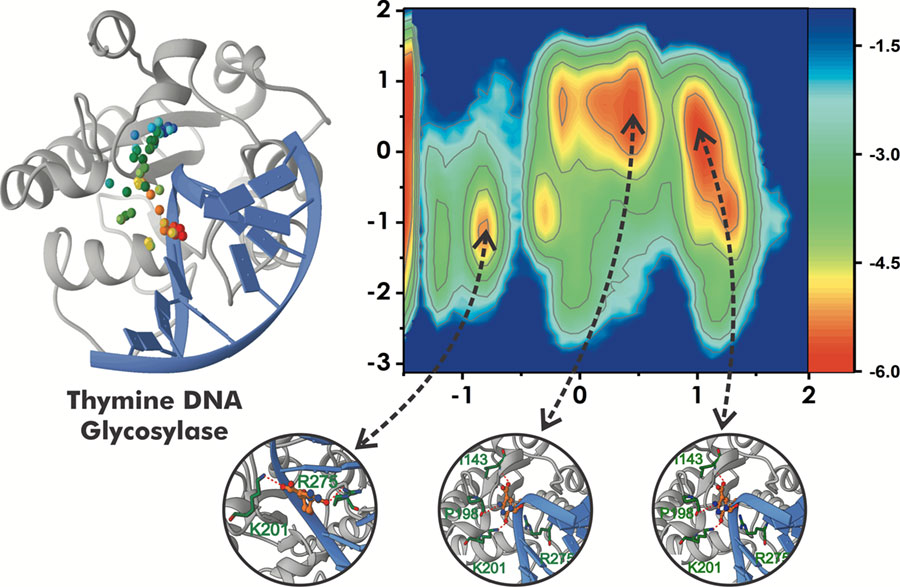
Repair enzymes that act on single bases
We also study enzymes that repair individual damaged or modified bases. We showed how the archetypal glycosylase TDG selects its substrates through a “pinch-push-pull” mechanism, how the glycosylase AlkD sculpts DNA to extrude and excise damaged bases, and how endonuclease IV uses three metal ions for catalysis.
Dodd et al., PNAS 2018; Kossmann & Ivanov, PLOS Computational Biology 2014; Ivanov et al., PNAS 2007
Current directions
We are now modeling the earliest committed steps of repair and the fully assembled lesion-scanning complex, and computing the transitions that connect the five stages of the NER cascade, from damage recognition to dual incision. The goal is a predictive classification of repair-deficiency mutations by mechanism, tested in reconstituted repair assays and single-molecule experiments by our collaborators.
Key papers
- Translocation mechanism of xeroderma pigmentosum group D protein on single-stranded DNA and genetic disease etiology
Paul, Yan, Derdeyn-Blackwell & Ivanov · Nature Communications 16, 11703 - Molecular model of TFIIH recruitment to the transcription-coupled repair machinery
Paul, Yan, Yu, Tsutakawa, Tainer, Wang & Ivanov · Nature Communications 16, 2341 - Molecular architecture and functional dynamics of the pre-incision complex in nucleotide excision repair
Yu, Yan, Paul, Brewer, Tsutakawa, Tsai, Hamdan, Tainer & Ivanov · Nature Communications 15, 8511 - Dynamic conformational switching underlies TFIIH function in transcription and DNA repair and impacts genetic diseases
Yu, Yan, Dodd, Tsai, Tainer, Tsutakawa & Ivanov · Nature Communications 14, 2758 - A scanning-to-incision switch in TFIIH-XPG induced by DNA damage licenses nucleotide excision repair
Bralić, … Ivanov, Tsutakawa, Tainer & Hamdan · Nucleic Acids Research - Mechanism of Rad26-assisted rescue of stalled RNA polymerase II in transcription-coupled repair
Yan, Dodd, Yu, Leung, Xu, Oh, Wang & Ivanov · Nature Communications 12, 7001 - Uncovering universal rules governing the selectivity of the archetypal DNA glycosylase TDG
Dodd, Yan, Kossmann, Martin & Ivanov · PNAS - Alkylpurine glycosylase D employs DNA sculpting as a strategy to extrude and excise damaged bases
Kossmann & Ivanov · PLOS Computational Biology 10, e1003704

