Research › Methods
Methods: from snapshots to mechanisms
Cryo-EM captures discrete snapshots drawn from much larger conformational ensembles. The switches, the allosteric signals and the disordered regions that make a machine work lie between those snapshots. Our methods recover the motions and energetics that connect the snapshots, turning a gallery of structures into a working mechanism.
Questions we ask
- How can heterogeneous data, from cryo-EM to crosslinking and scattering, be combined into one consistent model?
- How can a transition between two experimental structures be computed rather than guessed?
- How do signals travel through a megadalton assembly, and how does that wiring change between functional states?
What we have found

Integrative modeling and cryo-EM refinement
We combine high-resolution structures of individual components with cryo-EM maps, small-angle X-ray scattering, single-molecule FRET and crosslinking mass spectrometry to build models of large assemblies. We were among the first to embed AlphaFold predictions of large, multi-subunit assemblies within experimentally restrained frameworks, and we have reviewed simulation-based methods for building and refining models in cryo-EM maps.
Xu et al., CSBJ 2015; Dodd et al., JCIM 2020; Yu et al., Nature Communications 2024; Paul et al., Nature Communications 2025
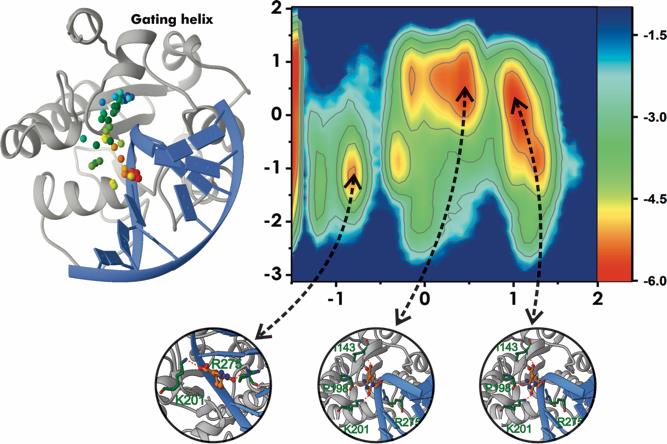
Free energy and transition pathways
Enhanced sampling and free energy methods let us compare mechanisms on a quantitative footing, from how a glycosylase selects its substrate to how a polymerase moves DNA between its active sites. Chain-of-replicas path optimization computes the transition between experimentally determined states directly, so that the pathway comes from the structures rather than being imposed.
Dodd et al., PNAS 2018; Dodd et al., Nature Communications 2020; Paul et al., Nature Communications 2025
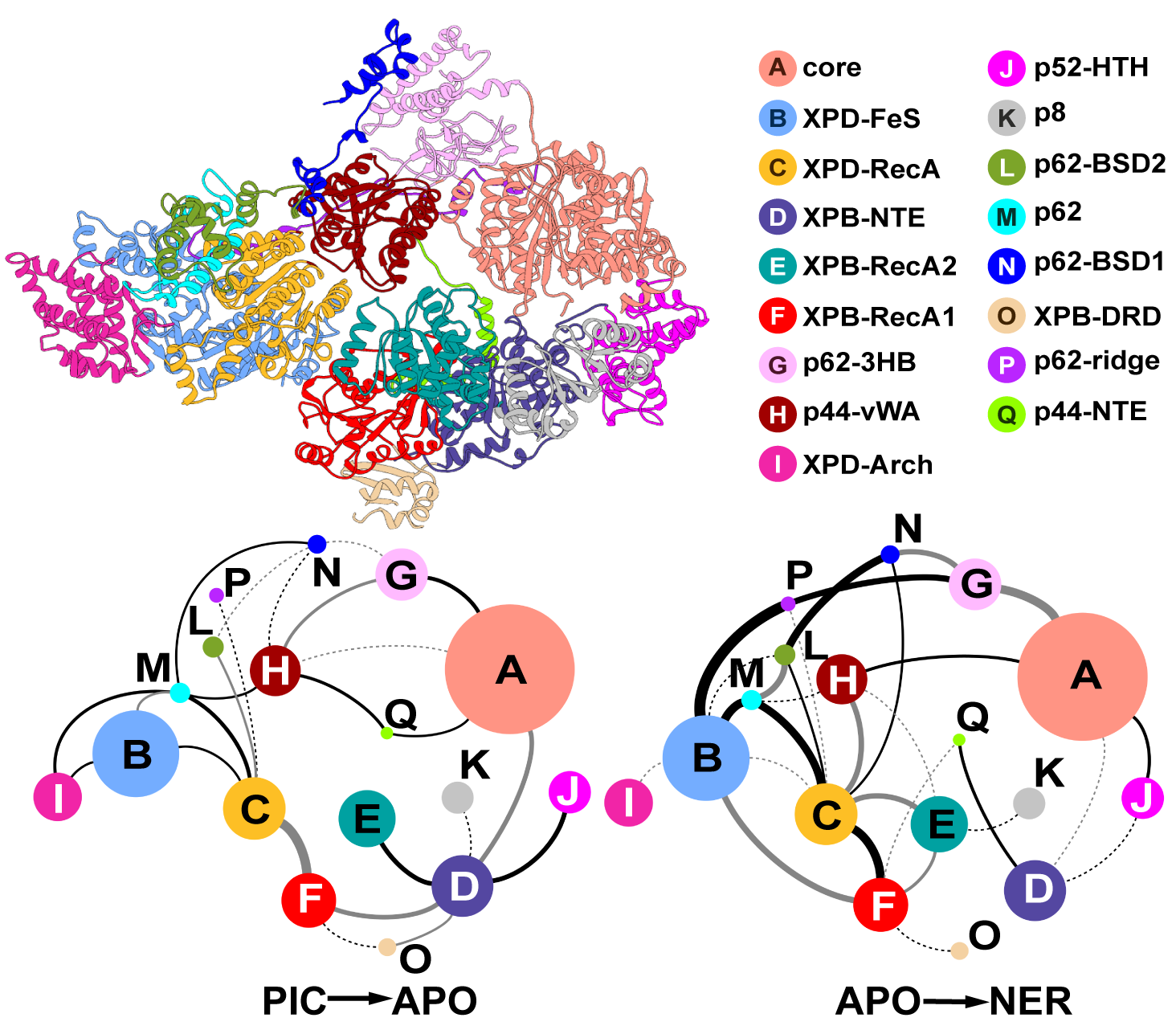
Network analysis of allosteric communication
We partition simulated assemblies into dynamic communities and trace the paths that carry signals between them. SOAN, our fast algorithm for computing suboptimal paths in protein dynamic networks, makes this practical for large assemblies, and our own implementation of difference contact network analysis (dCNA) scales to large assemblies and shows how communication is rewired when a machine changes state.
Dodd et al., Molecular Physics 2021
Current directions
We are joining these tools into one pipeline: AI-guided structure prediction and flexible fitting, path optimization, enhanced sampling and kinetic modeling, and network analysis, run on leadership-class supercomputers through the DOE INCITE program.
Key papers
- Subsets of adjacent nodes (SOAN): a fast method for computing suboptimal paths in protein dynamic networks
Dodd, Yao, Hamelberg & Ivanov · Molecular Physics - Simulation-based methods for model building and refinement in cryo-electron microscopy
Dodd, Yan & Ivanov · Journal of Chemical Information and Modeling 60, 2470–2483 - Integrative modeling of macromolecular assemblies from low to near-atomic resolution
Xu, Yan, Wohlhueter & Ivanov · Computational and Structural Biotechnology Journal 13, 492–503

