Research › DNA replication
DNA replication: copying the genome faithfully
Every cell division requires an accurate copy of the genome. The replisome, the machinery that duplicates DNA, is built from helicases that unwind the double helix, polymerases that copy each strand, and ring-shaped sliding clamps that hold the polymerases on DNA. Failures in this machinery cause the replication stress and genome instability that underlie cancer and inherited disease.
We model the moving parts of the replication fork, from loading of the helicase at origins to the proofreading switch of high-fidelity polymerases.
Questions we ask
- How is the replicative helicase loaded onto origin DNA?
- How are ring-shaped sliding clamps opened and placed on DNA?
- How does a high-fidelity polymerase move a mismatched primer from its polymerization site to its proofreading site?
- How do chemical modifications of the clamp redirect the replisome after DNA damage?
What we have found
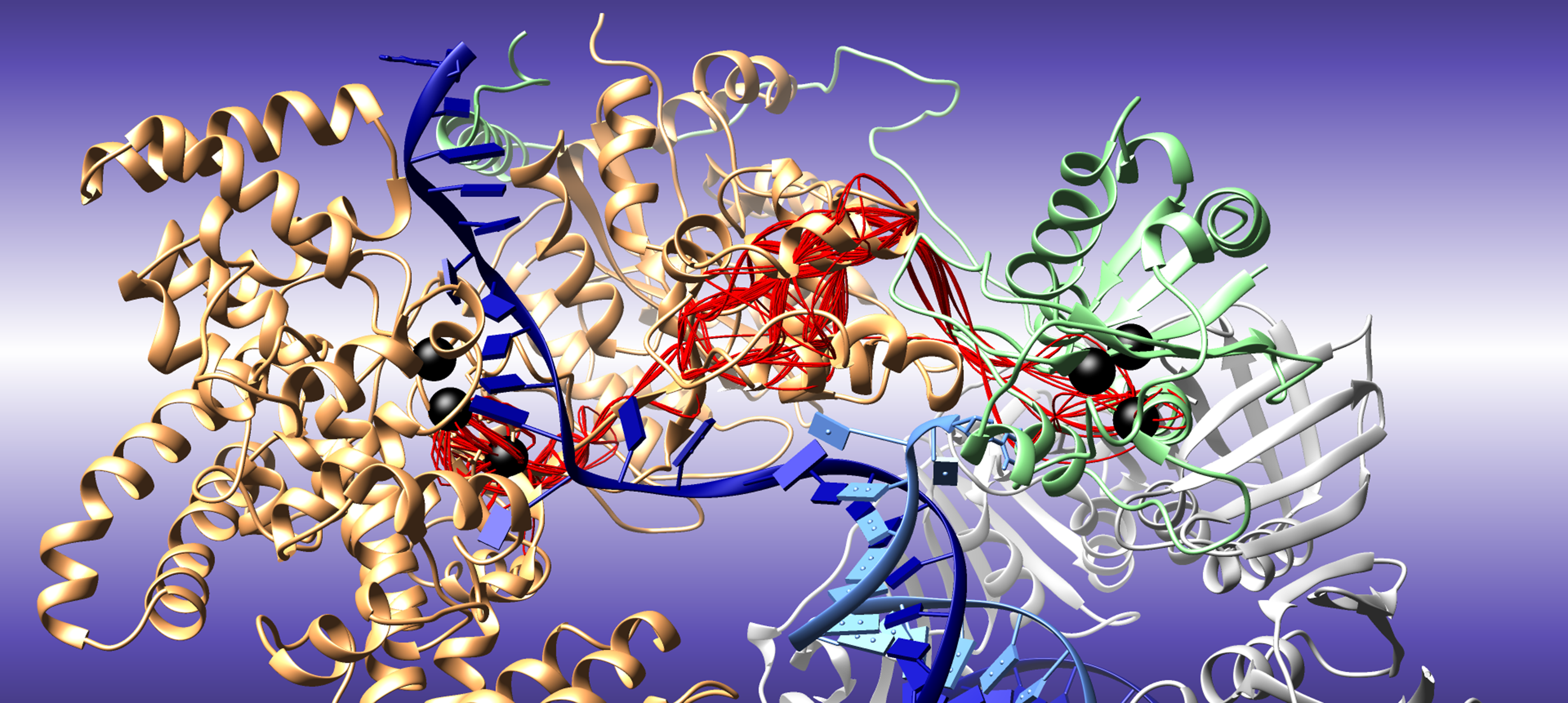
A defined path from copying to proofreading
Proofreading lets replicative polymerases remove misincorporated nucleotides, but the exonuclease site lies far from the polymerization site. Using recent cryo-EM structures, simulations and biochemistry, we traced an optimal free energy path connecting the two states of E. coli DNA polymerase III, identified structures for every intermediate, and showed that switching takes tens of milliseconds. Targeted mutations confirmed the mechanism.
Dodd et al., Nature Communications 2020; highlighted by the Oak Ridge Leadership Computing Facility
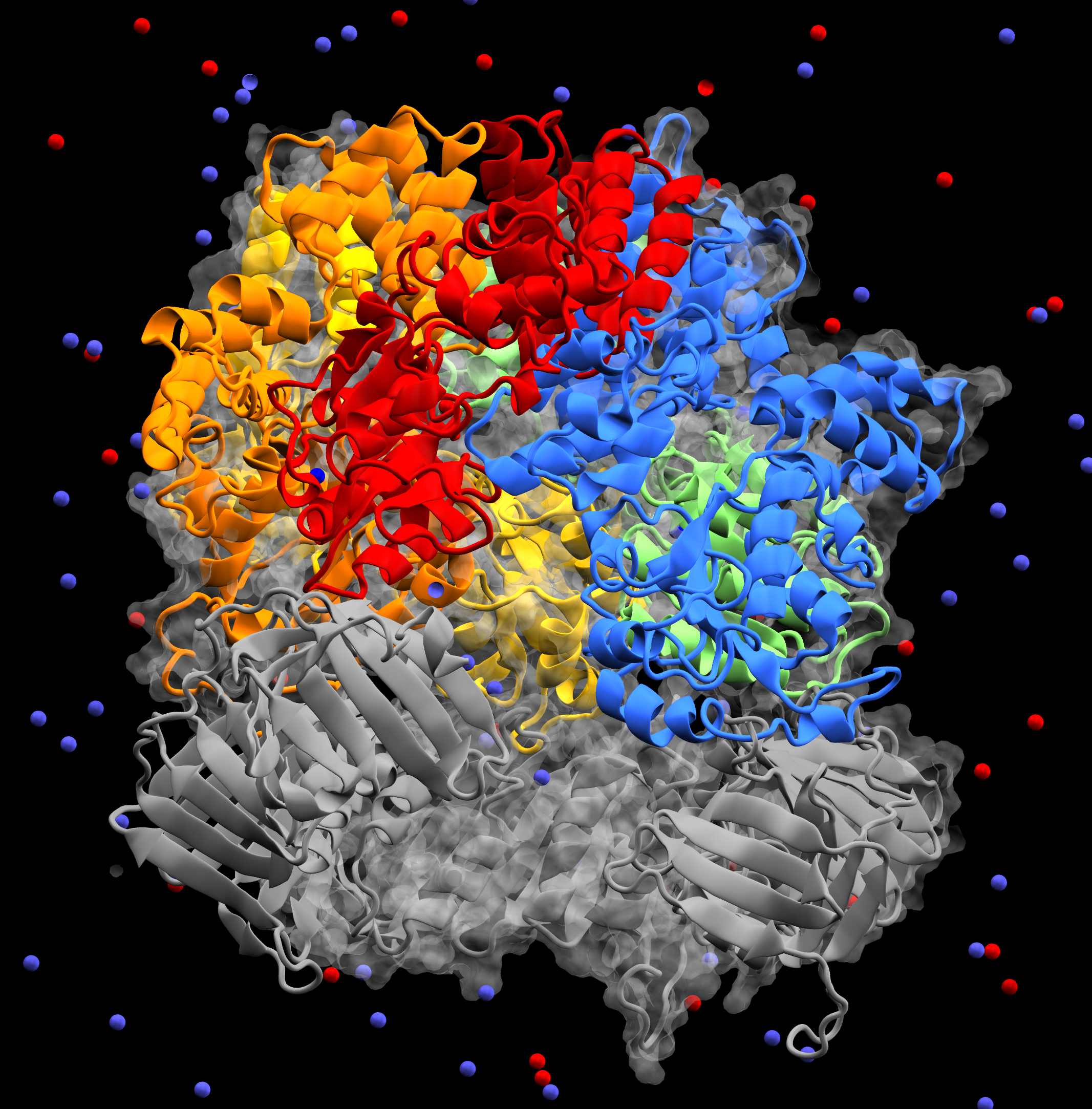
Opening and loading sliding clamps
We showed that the clamp loader replication factor C specifically recognizes the ring-opened state of PCNA, defined the opening pathways of PCNA and the alternative clamp Rad9-Rad1-Hus1, and identified a conserved anchor that keeps clamp subunit interfaces intact.
Tainer et al., JACS 2010; Xu et al., NAR 2013; Perumal et al., JMB 2019
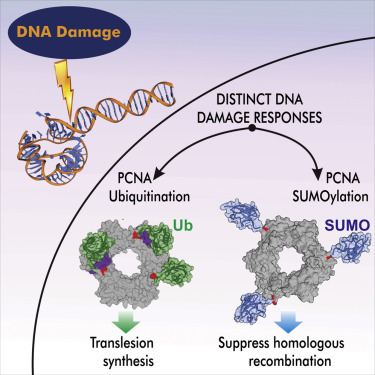
Clamp modifications in the DNA damage response
When replication meets DNA damage, PCNA is modified by ubiquitin or SUMO. Combining small-angle X-ray scattering with modeling, we showed that ubiquitin attached to PCNA samples multiple conformations, and that ubiquitin- and SUMO-modified PCNA are structurally distinct, with implications for their different roles.
Tsutakawa et al., PNAS 2011 (Faculty of 1000 recommended); Tsutakawa et al., Structure 2015
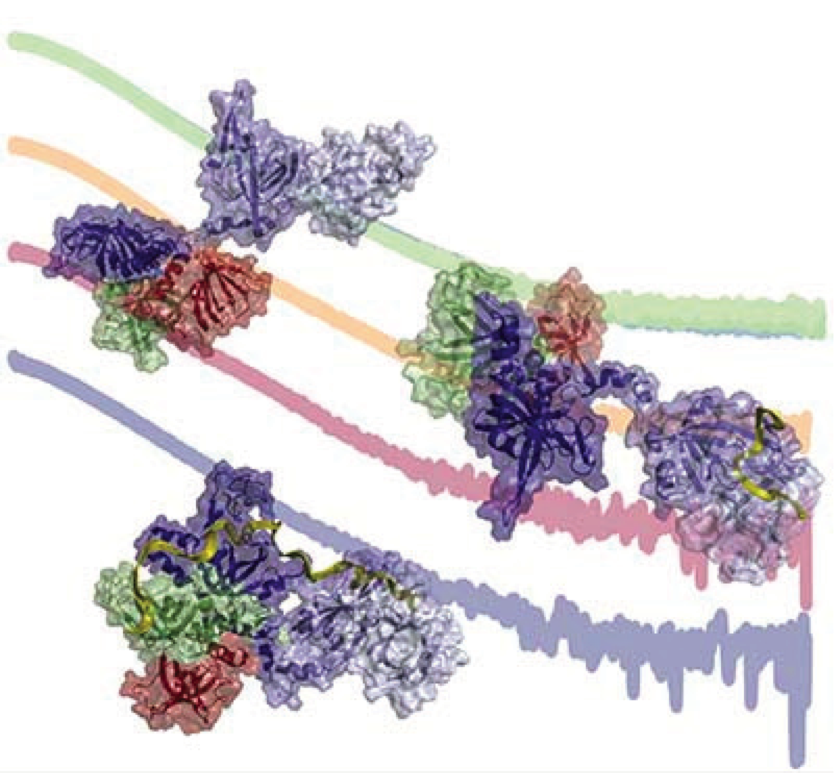
Loading the helicase and handling single-stranded DNA
We mapped the conformational and energetic landscape by which the Mcm2–7 helicase is loaded onto origin DNA by ORC–Cdc6. We also proposed a new structural framework for how replication protein A, the single-stranded DNA binding protein, is integrated into DNA processing machinery.
Yuan et al., PNAS 2020; Brosey et al., NAR 2013 (featured article)
Current directions
We are now turning to the central motor of replication, the CMG helicase, which unwinds DNA at every fork. Two competing pictures of how it moves, a rotary hand-over-hand mechanism and an inchworm-like mechanism, make different predictions that static structures cannot settle. We are placing both on a common quantitative footing and building progressively more complete replisome models to map how leading- and lagging-strand synthesis are coordinated.
Key papers
- Polymerization and editing modes of a high-fidelity DNA polymerase are linked by a well-defined path
Dodd, Botto, Paul, Fernandez-Leiro, Lamers & Ivanov · Nature Communications 11, 5379 - Structural mechanism of helicase loading onto replication origin DNA by ORC-Cdc6
Yuan, Schneider, Dodd, Riera, Bai, Yan, Ivanov, Stillman, Li & Speck · PNAS 117, 17747–17756 - Recognition of a key anchor residue by a conserved hydrophobic pocket ensures subunit interface integrity in DNA clamps
Perumal, Xu, Yan, Ivanov & Benkovic · Journal of Molecular Biology - Structurally distinct ubiquitin- and SUMO-modified PCNA: implications for their distinct roles in the DNA damage response
Tsutakawa, Yan, Xu, Weinacht, Freudenthal, Zhuang, Washington, Tainer & Ivanov · Structure 23, 724–733 - Opening pathways of the DNA clamps proliferating cell nuclear antigen and Rad9-Rad1-Hus1
Xu, Guardiani, Yan & Ivanov · Nucleic Acids Research 41, 10020–10031 - A new structural framework for integrating replication protein A into DNA processing machinery
Brosey, Yan, Tsutakawa, Heller, Rambo, Tainer, Ivanov & Chazin · Nucleic Acids Research 41, 2313–2327 - Solution X-ray scattering combined with computational modeling reveals multiple conformations of covalently bound ubiquitin on PCNA
Tsutakawa, Van Wynsberghe, Freudenthal, … Tainer & Ivanov · PNAS 108, 17672–17677 - Specific recognition of the ring-opened state of proliferating cell nuclear antigen by replication factor C promotes eukaryotic clamp-loading
Tainer, McCammon & Ivanov · JACS 132, 7372–7378

